Eleven people reconciling payments by hand, across multiple African markets
The Problem
A payments business operating across multiple African markets reconciled by hand. Eleven people, working around the clock, compared what each payment provider reported against what the bank actually received. Multiple currencies, multiple providers, multiple markets, every single day.
The process worked, but barely. It was slow, errors were hard to catch, and audits were painful. The business was also growing, which meant the problem compounded: more volume needed more people, and more people meant more places for a mismatch to hide.
An eleven-person reconciliation team, running around the clock, became one person spending ten minutes an hour on work that used to take forty-five.
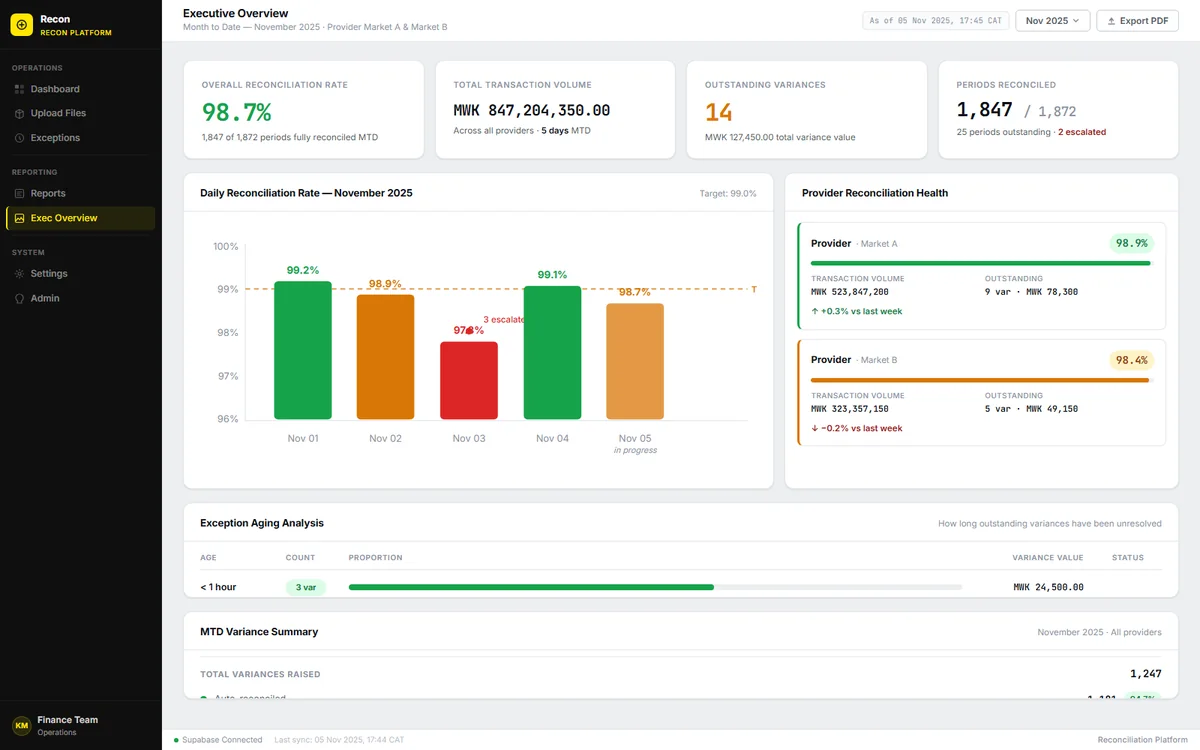
What Was Built
We built a custom reconciliation platform from the ground up. It connects directly to the mobile money and payment provider APIs operating in each market, pulls transaction data live, and matches it automatically against what the banks report.
The matching logic carries the complexity that made the manual process so slow: currency conversion across markets, timing differences between when a payment is initiated and when it settles, provider data formats that agree with each other on almost nothing, and the edge cases that never fit a standard pattern.
The platform runs on React (the interface the team uses to review and manage reconciliation) and Supabase (the database holding every transaction record, match result and audit entry). Slack notifications surface only the exceptions that need a human decision. Everything else reconciles without anyone touching it.
The reconciliation process
The Outcome
Reconciliation that occupied eleven people around the clock now occupies one, for ten minutes in the hour. The rest of that capacity went elsewhere in the business.
Every matched and unmatched record carries a full audit trail, so an audit that used to mean reconstructing a month by hand is now a query. And because the platform scales with transaction volume rather than with headcount, the business can keep growing without hiring against it.
Running a manual process that should be automated?
Get your free audit →